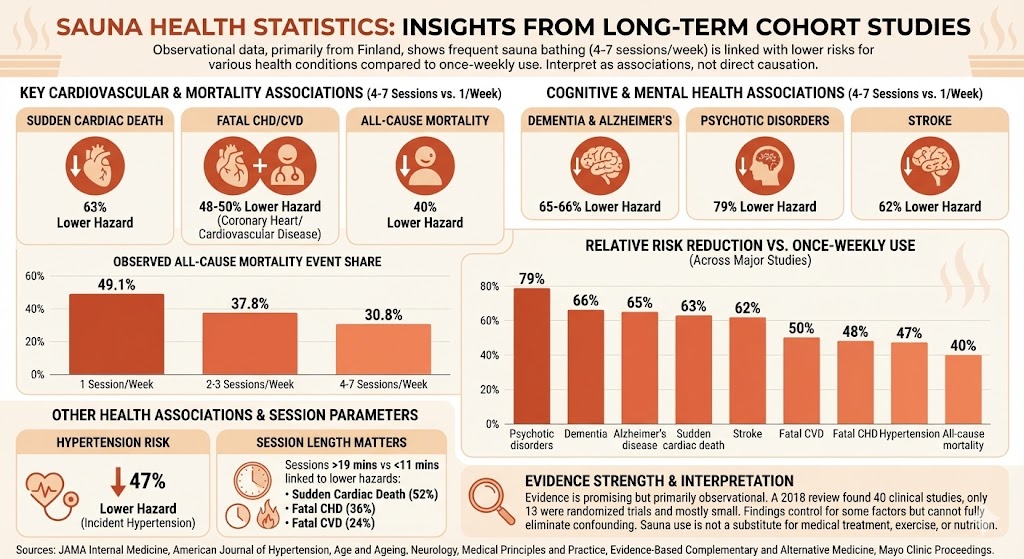
Sauna health statistics are strongest in long-term Finnish cohort studies, where more frequent sauna bathing is linked with lower rates of several cardiovascular, cognitive, and mental health outcomes. The biggest headline numbers usually compare people who used a sauna 4 to 7 times per week with those who used it once per week, and those results should be read as associations rather than proof of cause and effect.
sauna health statistics
The most consistent pattern in the data is dose response. Weekly frequency matters, and in one landmark mortality study the highest-use group had lower adjusted hazards for sudden cardiac death, fatal coronary heart disease, fatal cardiovascular disease, and all-cause mortality. Separate cohort studies also linked frequent sauna use with lower hazards for hypertension, dementia, Alzheimer’s disease, stroke, and psychotic disorders.
Key Sauna Health Statistics
In a 2,315-man Finnish cohort followed for a median of 20.7 years, 4 to 7 sauna sessions per week were linked with a 63% lower hazard of sudden cardiac death versus 1 session per week.
In the same cohort, 4 to 7 weekly sessions were linked with a 48% lower hazard of fatal coronary heart disease, a 50% lower hazard of fatal cardiovascular disease, and a 40% lower hazard of all-cause mortality.
Observed all-cause mortality event shares in that cohort were 49.1% for once-weekly users, 37.8% for 2 to 3 times weekly users, and 30.8% for 4 to 7 times weekly users.
In a 1,621-man cohort followed for a median of 24.7 years, 4 to 7 sauna sessions per week were linked with a 47% lower adjusted hazard of incident hypertension versus once-weekly use.
In a 2,315-man cohort, 4 to 7 weekly sessions were linked with a 66% lower hazard of dementia and a 65% lower hazard of Alzheimer’s disease versus once-weekly use.
In a 1,628-person cohort of men and women aged 53 to 74, frequent sauna use was linked with a 62% lower adjusted hazard of stroke.
In a 2,138-man cohort followed for a median of 24.9 years, 4 to 7 weekly sessions were linked with a 79% lower adjusted hazard of psychotic disorders.
Session length also mattered in the mortality study: more than 19 minutes per session was linked with a 52% lower hazard of sudden cardiac death, a 36% lower hazard of fatal coronary heart disease, and a 24% lower hazard of fatal cardiovascular disease compared with sessions under 11 minutes.
A 2018 systematic review found 40 clinical studies involving 3,855 participants, but only 13 were randomized trials and most were small, which is why the evidence base still leans heavily on observational research.
Sauna Health Statistics Chart (Relative Risk Reduction vs Once-Weekly Use)
This chart compares the largest adjusted relative risk reductions reported for frequent sauna use across major long-term cohort studies. Because these figures come from different studies and outcomes, they are best used to compare direction and scale rather than to rank benefits as if they came from one single trial.
The cardiovascular numbers are the most cited sauna health statistics because they come from a large prospective cohort with long follow-up. In that study, men reporting 4 to 7 sauna sessions per week had hazard ratios of 0.37 for sudden cardiac death, 0.52 for fatal coronary heart disease, 0.50 for fatal cardiovascular disease, and 0.60 for all-cause mortality compared with men who used a sauna once per week.
The middle group also looked favorable. Men using a sauna 2 to 3 times per week had hazard ratios of 0.77 for fatal coronary heart disease, 0.73 for fatal cardiovascular disease, and 0.76 for all-cause mortality versus once-weekly users. That matters because it suggests the pattern is not only a highest-use effect.
Sauna Health Statistics Chart (Longer Sessions and Cardiovascular Risk)
Frequency is not the only variable that shows up in the data. In the same mortality cohort, sessions lasting more than 19 minutes were linked with lower cardiovascular mortality hazards than sessions shorter than 11 minutes, although that longer duration did not show a significant difference for all-cause mortality.
Label
Bar
Value
Sudden cardiac death
52%
Fatal CHD
36%
Fatal CVD
24%
Max = 52. Widths: Sudden cardiac death 100.00%, Fatal CHD 69.23%, Fatal CVD 46.15%.
Cognitive and Mental Health Sauna Statistics
The cognitive and mental health findings are striking, but they are also narrower in scope than the cardiovascular studies because they are based on separate cohorts and mostly male populations. In the dementia cohort, men using a sauna 4 to 7 times per week had hazard ratios of 0.34 for dementia and 0.35 for Alzheimer’s disease versus once-weekly users. In the psychosis cohort, the corresponding adjusted hazard ratio was 0.21.
Those are large relative differences, but they should be interpreted carefully. They do not mean a sauna prevents dementia, Alzheimer’s disease, or psychosis on its own. They mean that, in these observational cohorts, frequent sauna users experienced substantially lower long-term event rates after adjustment for a range of confounders.
Stroke and Blood Pressure Sauna Statistics
Two other frequently cited sauna health statistics concern stroke and hypertension. In a Finnish cohort of 1,628 adults aged 53 to 74, the adjusted hazard ratio for stroke was 0.38 for people using the sauna 4 to 7 times weekly versus once weekly. In a separate 1,621-man cohort without hypertension at baseline, the fully adjusted hazard ratio for incident hypertension was 0.53 in the highest-frequency group.
These numbers are important because they help explain why sauna bathing is often discussed alongside cardiometabolic health. Blood pressure, vascular function, and circulation are plausible pathways, but the epidemiology still comes first here. The long-term cohort data are stronger than the mechanistic data for making statistical claims.
Sauna Health Statistics Chart (Observed All-Cause Mortality Event Share)
This chart uses observed event shares from the landmark mortality cohort rather than adjusted hazard ratios. It shows how the proportion of deaths during follow-up declined across higher weekly sauna frequency groups.
Label
Bar
Value
1 session/week
49.1%
2 to 3 sessions/week
37.8%
4 to 7 sessions/week
30.8%
Max = 49.1. Widths: 1 session/week 100.00%, 2 to 3 sessions/week 76.99%, 4 to 7 sessions/week 62.73%.
How Strong Is the Evidence?
The overall evidence base is promising but uneven. A 2018 systematic review found 40 clinical studies with 3,855 participants, yet only 13 were randomized trials and most were small. That means the biggest sauna health statistics still come from observational cohorts, especially in Finland, and those studies can control for many factors without fully eliminating confounding.
That evidence profile matters for interpretation. Sauna users may differ from nonusers in fitness, income, diet, social habits, or recovery routines, and some of those differences may contribute to the outcomes. Even so, the fact that multiple cohorts point in a similar direction makes sauna one of the more interesting passive heat exposures in public health research.
Bottom Line
If you are looking for the most defensible sauna health statistics, the best-supported claims are about lower long-term hazards for cardiovascular outcomes, hypertension, stroke, and some neurocognitive outcomes among frequent sauna users. The most repeated threshold in the literature is 4 to 7 sessions per week, which consistently outperforms once-weekly use in the strongest cohort data. The caution is that these are observational findings, not a substitute for exercise, sleep, nutrition, or medical treatment.
Sources
Laukkanen T, et al. Association between sauna bathing and fatal cardiovascular and all-cause mortality events. JAMA Internal Medicine, 2015. https://pubmed.ncbi.nlm.nih.gov/25705824/
Zaccardi F, et al. Sauna Bathing and Incident Hypertension: A Prospective Cohort Study. American Journal of Hypertension, 2017. https://pubmed.ncbi.nlm.nih.gov/28633297/
Laukkanen T, et al. Sauna bathing is inversely associated with dementia and Alzheimer’s disease in middle-aged Finnish men. Age and Ageing, 2017. https://pubmed.ncbi.nlm.nih.gov/27932366/
Kunutsor SK, et al. Sauna bathing reduces the risk of stroke in Finnish men and women: A prospective cohort study. Neurology, 2018. https://pubmed.ncbi.nlm.nih.gov/29720543/
Laukkanen T, et al. Sauna Bathing and Risk of Psychotic Disorders: A Prospective Cohort Study. Medical Principles and Practice, 2018. https://pubmed.ncbi.nlm.nih.gov/30173212/
Hussain J, Cohen M. Clinical Effects of Regular Dry Sauna Bathing: A Systematic Review. Evidence-Based Complementary and Alternative Medicine, 2018. https://pmc.ncbi.nlm.nih.gov/articles/PMC5941775/
Laukkanen JA, Kunutsor SK. Cardiovascular and Other Health Benefits of Sauna Bathing. Mayo Clinic Proceedings, 2018. https://www.mayoclinicproceedings.org/article/S0025-6196(18)30275-1/fulltext